Businesses are increasingly connecting physical devices, sensors, machines, vehicles, and equipment to software platforms to collect data, automate processes, and improve operational visibility. IoT Development Services in India help organizations build connected systems that bring devices, applications, cloud infrastructure, analytics, and users together.
A modern IoT solution is more than connecting a sensor to the internet. It may require device authentication, data ingestion, communication protocols, device management, real-time monitoring, cloud processing, dashboards, alerts, and integration with existing business applications. Google Cloud's connected-device architecture guidance highlights device scale, fleet management, and inter-device messaging as important factors when selecting an IoT architecture.
What Is IoT Application Development?
IoT Application Development is the process of creating software that communicates with connected devices and turns device-generated information into useful business data and actions.
An IoT application can include:
- Connected device integration
- Sensor data collection
- Device authentication
- Cloud connectivity
- Real-time dashboards
- Data storage
- Analytics
- Alerts and notifications
- Remote device monitoring
- Device control
- API integration
- Mobile applications
- Business system integration
The application layer is responsible for helping businesses understand and act on information generated by connected equipment.
For example, a manufacturing business could use IoT software to monitor machine conditions, while a logistics company could use connected devices to track assets and collect location or environmental information.
What Does an IoT Application Development Company Do?
An IoT Application Development Company designs and develops the software components required to operate connected-device ecosystems.
The work can cover the complete journey from device connectivity to business applications.
IoT Strategy and Requirement Analysis
Development begins by identifying:
- What devices need to be connected
- What information they generate
- How frequently data is transmitted
- Where the devices operate
- How many devices are expected
- What users need to see
- Which systems require integration
- What security requirements apply
- How the platform may scale
These decisions influence the architecture and technology used for the project.
Device and Cloud Connectivity
An IoT system needs a reliable communication layer between devices and backend applications.
Depending on the project, technologies and protocols can include MQTT, HTTPS, Bluetooth Low Energy, Wi-Fi, cellular connectivity, gateways, and other communication methods.
Google Cloud's IoT architecture documentation describes MQTT and HTTPS as common data-connectivity approaches and highlights device provisioning, authentication, configuration, telemetry, and management as important platform capabilities.
IoT Dashboard Development
Dashboards allow businesses to transform device data into useful operational information.
A dashboard may show:
- Device status
- Temperature
- Location
- Energy consumption
- Production metrics
- Equipment health
- Alerts
- Historical trends
- Sensor readings
The interface should present the information that users actually need rather than overwhelming them with raw telemetry.
Why Choose an IoT Application Development Company in India?
An iot application development company in india can support businesses that need customized connected-device software for different industries and operational environments.
When selecting a development partner, businesses should evaluate:
- IoT architecture experience
- Cloud platform expertise
- Device integration capabilities
- Security practices
- API development skills
- Data engineering experience
- Dashboard development
- Mobile application capabilities
- Testing processes
- Post-launch support
The right development partner should understand both the software requirements and the physical environment in which connected devices operate.
What Are the Key IoT Development Services in India?
Professional IoT development can include several layers.
1. IoT Platform Development
A centralized platform can receive device information, manage devices, process data, and provide information to business applications.
2. Device Management
Large deployments need mechanisms for identifying devices, monitoring their status, managing configurations, and handling updates.
Google Cloud's IoT architecture guidance specifically identifies capabilities such as device credential storage, authentication, authorization, configuration management, device registries, and update management as important components of IoT platforms.
3. Data Processing
Connected devices can generate large volumes of information. A suitable architecture should determine how data is ingested, processed, stored, analyzed, and delivered to applications.
4. Real-Time Monitoring
Businesses can use dashboards and alerts to monitor connected equipment and respond to important events.
5. API and Enterprise Integration
IoT systems can exchange information with ERP, CRM, inventory, analytics, mobile, and other business platforms through APIs and integration services.
How Does an IoT Development Company in India Build Scalable Solutions?
An IoT Development Company in India should consider scalability from the beginning.
A system designed for ten devices may require a very different architecture from one expected to support thousands or millions of connected devices.
Important considerations include:
- Number of connected devices
- Data transmission frequency
- Message volume
- Device locations
- Connectivity reliability
- Storage requirements
- Real-time processing needs
- Security requirements
- Fleet management
- Future device expansion
Google Cloud's architecture guidance notes that different connected-device architectures support different device scales and management requirements.
This means businesses should choose architecture according to their actual use case rather than selecting technology simply because it is popular.
How Important Is Security in IoT Development?
Security is fundamental to connected-device applications because devices communicate with backend systems and may control or monitor physical environments.
A secure IoT architecture can include:
- Device identity
- Authentication
- Authorization
- Encrypted communication
- Credential management
- Secure provisioning
- Access controls
- Monitoring
- Software and firmware updates
- Data protection
Google Cloud's IoT backend guidance specifically discusses certificate provisioning, device authentication, authorization, and secure connections between edge devices and cloud resources.
Security should therefore be considered during architecture and development rather than added after deployment.
What Are the Benefits of IoT Solutions for Businesses?
Connected-device software can provide several operational benefits.
Better Operational Visibility
Businesses can monitor assets and equipment without depending entirely on manual data collection.
Faster Decision-Making
Real-time information can help teams respond to operational events more quickly.
Automation
IoT systems can trigger notifications, workflows, or actions based on defined conditions.
Predictive Maintenance
Equipment data can help organizations identify unusual conditions and develop maintenance strategies.
Asset Tracking
Connected devices can provide information about the location and status of assets.
Resource Management
IoT systems can help businesses monitor energy, equipment utilization, environmental conditions, and other measurable resources.
The actual benefits depend on the quality of the data, system design, connectivity, and how effectively the information is integrated into business processes.
Best IoT Development Companies in Jaipur: What Should Businesses Evaluate?
Businesses searching for the Best IoT Development Companies in Jaipur should compare providers based on technical capabilities and relevant project experience rather than relying only on rankings or promotional claims.
Consider whether the company can handle:
- IoT application development
- Device integration
- Cloud architecture
- API development
- Real-time dashboards
- Mobile IoT applications
- Data processing
- Device management
- Security
- Testing
- Maintenance
Jaipur businesses can also benefit from choosing a development team that understands the local business environment while still having the technical capability to build solutions for customers and operations beyond the city.
How Can the Best IoT Application Development Company in Jaipur Help?
The Best IoT Application Development Company in Jaipur for a particular project should be the provider whose technical capabilities align with that project's requirements.
A complete IoT application may require:
- Business requirement analysis
- IoT architecture planning
- Device connectivity
- Backend development
- Cloud integration
- Database and telemetry storage
- Dashboard development
- Mobile application development
- API integration
- Security implementation
- Testing
- Deployment and maintenance
A development team that can coordinate these components can reduce the complexity of managing separate technology providers.
What Industries Can Use IoT Application Development?
IoT applications can support many industries.
Manufacturing
Monitor machines, production processes, equipment conditions, and operational metrics.
Logistics
Track vehicles, shipments, containers, and other assets.
Healthcare
Connect appropriate medical or monitoring devices to software systems where applicable security and regulatory requirements are met.
Agriculture
Monitor environmental conditions, irrigation systems, soil information, and agricultural equipment.
Retail
Support smart inventory, environmental monitoring, asset tracking, and connected store operations.
Energy
Monitor consumption, equipment status, and infrastructure conditions.
Smart Buildings
Connect sensors and systems for monitoring occupancy, environmental conditions, energy usage, and building equipment.
The architecture should always be designed around the specific industry's operational and security requirements.
How Does an IoT Application Development Company Create a Reliable IoT Platform?
Reliability starts with architecture.
An IoT development team should consider:
- Device connectivity failures
- Intermittent networks
- Data duplication
- Offline devices
- Message delivery
- Device authentication
- Monitoring
- Error handling
- Data retention
- Backup and recovery
- System scaling
Connected-device systems may also require edge or gateway components when devices operate in environments with unreliable connectivity or where local processing is beneficial.
Google Cloud documents multiple connected-device architectures, including gateway-based and direct cloud-ingestion approaches, demonstrating that the right architecture depends on device count, network environment, and application requirements.
Why Choose Orbit Infotech for IoT Development?
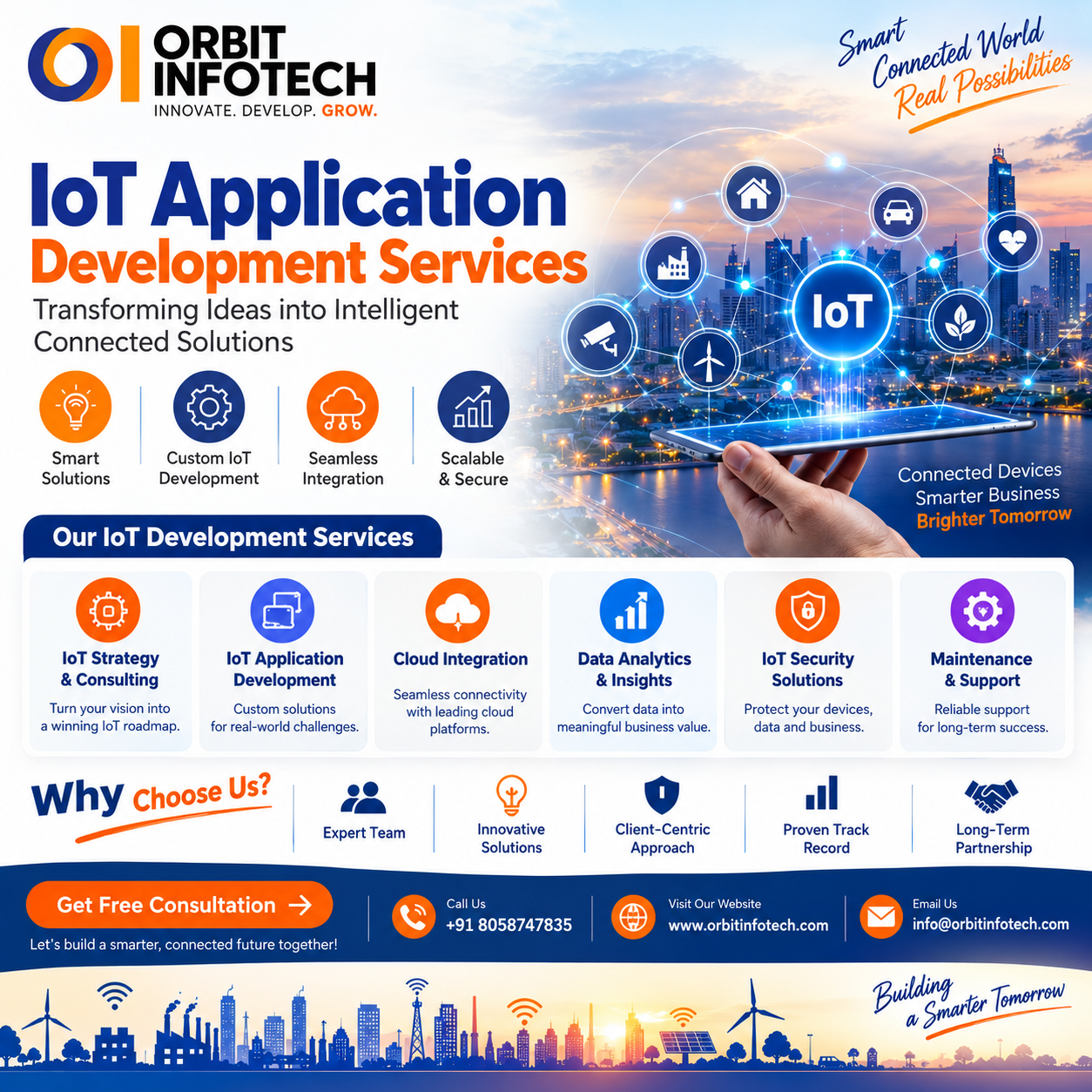
Orbit Infotech can help businesses plan and develop customized IoT applications around their operational requirements.
An end-to-end approach can combine application development, APIs, cloud connectivity, dashboards, data processing, device integration, security, testing, and ongoing support.
For organizations starting with an IoT prototype, the architecture should also leave a practical path toward production deployment and future expansion.
The goal is to turn connected-device data into useful business information rather than simply collecting telemetry.
Frequently Asked Questions
What is an IoT application development company?
An IoT application development company builds software that connects devices, sensors, cloud systems, databases, dashboards, and business applications. Services can include device integration, backend development, real-time monitoring, data processing, APIs, and device management.
What does an IoT Development Company in India provide?
An IoT Development Company in India can provide IoT application development, cloud integration, device connectivity, dashboards, APIs, data processing, security, device management, testing, and maintenance.
How much does IoT application development cost in India?
There is no fixed cost. Pricing depends on the number and type of devices, connectivity requirements, software complexity, cloud infrastructure, dashboards, integrations, security requirements, development timeline, and maintenance needs.
What is the difference between IoT software and traditional software?
Traditional software may primarily process information entered or generated within digital systems. IoT software additionally communicates with physical devices and processes information generated by sensors, machines, vehicles, or other connected equipment.
How can IoT help businesses?
IoT can provide real-time operational visibility, automation, asset monitoring, equipment insights, data collection, alerts, and integration with business applications. The value depends on how effectively the collected data is converted into useful actions.
Why is IoT security important?
IoT devices communicate with backend systems and may operate in physical environments. Strong identity, authentication, authorization, encrypted communication, credential management, monitoring, and secure updates can help reduce security risks.
What should I look for in an IoT application development company?
Look for experience in IoT architecture, device integration, cloud platforms, APIs, security, dashboards, data processing, testing, and long-term maintenance. Relevant experience with your industry or use case is also valuable.
Can an IoT application scale as the number of devices increases?
Yes, if scalability is considered during architecture planning. Device volume, telemetry frequency, messaging, storage, fleet management, and processing requirements should all be evaluated before deployment.
Which industries can benefit from IoT development?
Manufacturing, logistics, agriculture, healthcare, retail, energy, smart buildings, transportation, and many other industries can use IoT where connected devices can provide useful operational data or automation opportunities.
Also Read: Software Development Services for Scalable Business Solutions